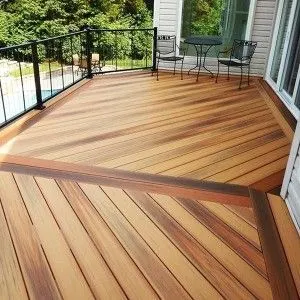
South Florida is not a forgiving environment for outdoor structures. Intense UV radiation, salt air within 20 to 30 miles of the coast, more than 60 inches of annual rainfall, sustained 90-degree heat, and the threat of hurricane-force winds together eliminate materials and methods that work perfectly elsewhere. A deck that would last 25 years in a dry inland climate can need rebuilding in Fort Lauderdale within 8 to 10 years if the wrong decisions are made at the start.
This guide covers everything that actually matters when you are building a deck in Broward County or Miami-Dade: choosing materials that survive the climate, the framing and fasteners that decide real lifespan, hurricane code, permits, honest 2026 cost numbers, and the mistakes that quietly ruin South Florida decks. It is written from years of building and repairing decks across South Florida, not copied from a national price guide.
Material Selection: The Most Important Decision You'll Make
The single biggest factor in how long a South Florida deck lasts, and how much it costs you over its lifetime, is the decking material. The two realistic choices for most homeowners are pressure-treated wood and composite. Here is how they compare in real Florida conditions.
🌳 Pressure-Treated Wood
- ✓ Lower upfront cost
- ✓ Easier to work with for custom shapes
- ✓ Available everywhere, fast lead times
- ✗ Requires sealing every 1 to 2 years in South Florida
- ✗ Warps, splinters, and grays quickly in Florida heat
- ✗ Termite risk if treatment lapses
- ✗ Lifespan of 10 to 15 years with maintenance
🔩 Capped Composite Decking
- ✓ 25 to 30 year lifespan in Florida conditions
- ✓ No annual sealing or staining
- ✓ Doesn't rot, warp, or splinter
- ✓ Termite proof by nature
- ✗ Higher upfront cost
- ✗ Darker colors get hot in direct sun
- ✗ Uncapped composite can fade — buy capped
For South Florida, the recommendation is capped composite, almost every time. The cost gap closes within 10 to 15 years once you account for sealing, staining, and early replacement of wood. Trex, TimberTech, and Fiberon all make product lines designed for coastal and high-humidity climates. The detail to insist on is capped composite — boards with a hard protective shell bonded to all four sides that resists moisture intrusion and UV fading. Uncapped composite is cheaper and a poor choice for the Florida sun.
What about tropical hardwood and aluminum?
Ipe and other tropical hardwoods are beautiful and extremely durable, but they are expensive, heavy, and demanding to install. Aluminum decking is the most maintenance-free option of all and stays cooler underfoot than composite, but it carries a premium price and a specific look that not every homeowner wants. For the large majority of South Florida homes, capped composite remains the practical sweet spot between cost, durability, and appearance.
The Frame and Fasteners: Where Florida Decks Actually Fail
Homeowners obsess over the decking surface and ignore what holds it up. In South Florida, the frame and the fasteners are where decks fail first.
Salt air and fastener corrosion
This is the detail that separates a deck built by someone who knows South Florida from one that does not. Homes within roughly 20 to 30 miles of the coast sit in salt-laden air. Standard galvanized screws, joist hangers, and connectors corrode in that environment. The decking surface can still look perfect while the hardware holding the structure together quietly rusts away.
For coastal South Florida decks, structural fasteners and connectors should be stainless steel or specially coated hardware rated for coastal and saltwater exposure. It is a small line item on the estimate and the single cheapest insurance you can buy for the life of the deck. A deck is only as strong as the connections, and in salt air those connections are the first thing to go if the wrong hardware was used.
Hurricane Code and Wind Uplift
A deck in South Florida is not just a floor — in a storm it is a surface that wind can grab and lift. The Florida Building Code treats decks accordingly, and Miami-Dade and coastal Broward enforce some of the strictest wind-load requirements in the country.
The two things that matter structurally are uplift (wind trying to peel the deck away from the house and the ground) and lateral load (wind and live load trying to push it sideways). A code-compliant South Florida deck addresses both with engineered connections: a properly bolted ledger board where the deck attaches to the house, hurricane-rated clips and hold-downs tying joists to beams and beams to posts, and footings sized and embedded to resist uplift. A deck that simply rests on the structure without these connections is both a code violation and a genuine hazard in a named storm.
This is also why Miami-Dade frequently requires engineered drawings: an attached or elevated deck has to be shown to handle hurricane wind uplift before a permit is issued. It is not bureaucracy for its own sake — it is the difference between a deck that stays put in a Category 3 and one that becomes airborne debris.
Permits in Fort Lauderdale, Broward County, and Miami-Dade
Decks require permits in virtually every jurisdiction in South Florida. Skipping the permit is the most expensive shortcut a homeowner can take. Here is the practical breakdown.
Broward County / Fort Lauderdale
Any deck attached to the structure, any deck more than 30 inches above grade, and most decks over 200 square feet require a permit. The City of Fort Lauderdale processes residential deck permits through its Building Services Division, and timelines typically run a few weeks for a straightforward residential deck. You will need drawings showing dimensions, connection details, and footing specifications. Other Broward cities — Hollywood, Pompano Beach, Coral Springs, Davie, Plantation — run their own building departments with similar but not identical requirements.
Miami-Dade
Miami-Dade enforces High Velocity Hurricane Zone requirements, which means stricter wind-load standards and, in many cases, engineered drawings or pre-engineered span tables. Permit review can take longer here than in Broward. Do not skip it: Miami-Dade inspectors actively flag unpermitted structures during real estate transactions, and an open permit issue can stall or kill a home sale.
The Deck Permit Process, Step by Step
For homeowners who have never pulled a permit, the process is less mysterious than it sounds. A typical South Florida deck permit runs roughly like this:
- HOA architectural approval — submit your design to the HOA and get written approval before anything else.
- Drawings and documents — a site plan, deck dimensions, framing and connection details, and footing specifications. Miami-Dade and many coastal projects also need engineering.
- Permit application — submitted to the city or county building department with the drawings and applicable fees.
- Plan review — the building department checks the plans against the Florida Building Code and may return comments to address.
- Permit issued — once approved, construction can legally begin.
- Inspections — typically a footing/foundation inspection before concrete is poured, a framing inspection before the deck boards go down, and a final inspection.
- Final approval — the permit is closed out and the deck is legally on the record, which is exactly what a future buyer's inspector will want to see.
A licensed contractor who works in your specific city handles this process routinely and knows what each building department wants, which is the main reason a permitted deck rarely stalls when an experienced builder pulls it.
What Does a Deck Cost in Fort Lauderdale or Miami? (2026 Numbers)
Deck pricing rose noticeably over the past few years with material and labor costs. The figures below reflect typical installed pricing in South Florida as of 2026. Treat them as planning ranges — the only accurate number comes from an on-site estimate, because height, railing type, site access, stairs, and product tier all move the price.
| Deck Type / Item | Cost Per Sq Ft (Installed) | 300 Sq Ft Example |
|---|---|---|
| Pressure-treated wood | $25 – $45 | $7,500 – $13,500 |
| Composite (mid-grade) | $40 – $55 | $12,000 – $16,500 |
| Composite (premium capped) | $55 – $70 | $16,500 – $21,000 |
| Permit + inspections | — | $800 – $1,800 |
| Aluminum railing | $70 – $100/linear ft | Varies by perimeter |
| Cable railing | $120 – $200/linear ft | Premium coastal look |
A useful way to read these numbers: the headline per-square-foot figure includes the substructure, decking surface, and basic railing, but stairs, elevated framing, premium railings, and difficult site access all add to it. The wide spread inside "composite" reflects how much product tiers differ — an entry-level capped board and a premium cellular-PVC board are both "composite" but sit at opposite ends of the range.
Deck or Paver Patio? Choosing the Right One
Before committing to a deck, it is worth asking whether a deck is even the right structure. The honest answer depends on the yard.
- A paver patio makes sense on flat ground at grade. It has very low maintenance, no framing to rot, and no wind-uplift concerns. The limitation is that it can only sit at ground level.
- A deck is the right call when the yard slopes, when the back door sits well above the ground, when you want a level finished surface over uneven terrain, or when you want the look and feel of a raised wood-tone platform.
Plenty of South Florida homes end up with both — a paver patio at grade for the grill and seating, and a raised deck stepping down from the back door. If you are unsure, an on-site look at your specific grade and door height settles the question quickly.
Design Considerations for South Florida Decks
- Shade — an uncovered deck in Fort Lauderdale or Miami is nearly unusable from May through October between 11 a.m. and 4 p.m. Budget for a pergola, shade sail, or roof extension if you want to actually use the space in summer.
- Drainage — South Florida gets sudden, heavy rain. The frame needs proper spacing and the grade underneath has to allow water to drain away. Standing water under a deck accelerates rot and breeds insects and mosquitoes.
- Surface heat — darker composite colors in direct South Florida sun can become uncomfortably hot underfoot. Lighter colors and product lines engineered for heat dissipation are worth the slightly higher cost, especially if children or pets will use the deck.
- Lighting — low-voltage LED deck lighting adds real nighttime usability and is inexpensive when wired in during the build. Added afterward, it becomes a costly retrofit. Plan it in from the start.
- Screen enclosure readiness — many South Florida homeowners eventually screen in a deck to keep mosquitoes out. If that is even a possibility, framing the deck to accept a future screen enclosure now saves a major rebuild later.
5 Mistakes That Ruin South Florida Decks
- Skipping the permit. An unpermitted deck routinely has to be torn out or retroactively permitted at a buyer's demand. It turns a home improvement into a liability the moment you list the house.
- Using galvanized hardware near the coast. Salt air corrodes standard fasteners and connectors. The deck boards look fine while the structure weakens out of sight.
- Choosing uncapped composite to save money. Uncapped composite fades and stains in the Florida sun. The small upfront saving costs you the appearance of the deck within a few years.
- Ignoring drainage under the deck. Standing water under the frame causes rot and becomes a mosquito breeding ground. Grade and spacing have to be planned, not assumed.
- Building no shade into the plan. A deck with no pergola, sail, or cover sits unused for half the year in South Florida heat. Shade is not a luxury here — it is what makes the deck usable.
Resale Value: Does a Deck Pay You Back?
A well-built, fully permitted deck is consistently one of the stronger home improvements for resale value. National remodeling data shows deck additions recoup a large share of their cost when the home sells, and in South Florida — where outdoor living is a year-round expectation — a quality deck is a genuine selling point.
The decisive word is permitted. A permitted, code-compliant deck adds value and shows up cleanly on an inspection. An unpermitted deck does the opposite: buyers and inspectors treat it as a problem to be priced down or removed. Doing the permit correctly is not just about avoiding a fine — it is what protects the deck as an asset.
Thinking About a Deck in Fort Lauderdale or Miami?
We'll come out, measure the space, walk through materials and options, and give you a real number. Licensed, insured, and familiar with permit and hurricane-code requirements across Broward and Miami-Dade.
(954) 805-8057Deck Building FAQs — South Florida
Yes. Any deck attached to the home, any deck more than 30 inches above grade, and most decks over 200 square feet require a permit in Fort Lauderdale and Broward County. Even detached ground-level decks often need permits depending on square footage and HOA rules. Building without a permit creates problems when selling, because unpermitted structures usually have to be removed or retroactively permitted, which is expensive and slow.
Capped composite decking is the best overall choice for South Florida. It handles UV exposure, heat, humidity, and salt air far better than pressure-treated wood. Quality capped composite from Trex, TimberTech, or Fiberon will not rot, will not splinter, and does not need annual staining or sealing. The upfront cost is higher than wood, but total cost of ownership over 10 to 15 years is lower once you account for maintenance and earlier replacement of wood.
As of 2026, a pressure-treated wood deck in South Florida typically runs $25 to $45 per square foot installed, and composite decking typically runs $40 to $70 per square foot installed. A 300 square foot deck costs roughly $7,500 to $13,500 for wood or $12,000 to $21,000 for composite. Add $800 to $1,800 for permits and inspections. Exact pricing depends on height, railing type, site access, and product tier.
A pressure-treated wood deck in South Florida typically lasts 10 to 15 years with consistent annual maintenance. A capped composite deck built on a properly treated frame with corrosion-resistant fasteners typically lasts 25 to 30 years. The frame and fasteners, not the deck surface, usually decide real lifespan, because that is where rot and corrosion start.
Decks within roughly 20 to 30 miles of the South Florida coast should use stainless steel or specially coated structural fasteners and connectors rated for coastal and saltwater exposure. Standard galvanized hardware corrodes quickly in salt air, which weakens the structure long before the deck boards show any wear.
In many cases, yes. Miami-Dade County enforces High Velocity Hurricane Zone wind-load requirements, so attached and elevated decks frequently need engineered drawings or pre-engineered span tables that account for hurricane wind uplift. A licensed contractor familiar with local building departments can tell you whether your specific project triggers the engineering requirement.
It depends on the yard. A paver patio works well on flat ground at grade and has very low maintenance. A deck is the better choice when the yard slopes, when the back door sits well above the ground, or when you want a finished surface over uneven terrain. Many South Florida homes end up with both — a paver patio at grade and a raised deck off the door.
The dry season from roughly November through April is the easiest time to build a deck in South Florida. Daily rain during the summer wet season slows framing and inspections, and permit and HOA timelines mean that starting the planning process two to three months before you want to use the deck is realistic.
Yes. A well-built, fully permitted deck is consistently one of the stronger resale-value home improvements, and national remodeling data shows deck additions recoup a large share of their cost at resale. The key word is permitted. An unpermitted deck can reduce value because buyers and inspectors treat it as a liability.
Building a deck in South Florida done right comes down to a few non-negotiables: capped composite over a pressure-treated frame, corrosion-resistant hardware, code-compliant hurricane connections, and a real permit. Get those right and the deck lasts for decades. Get them wrong and the climate finds the weak point fast. If you want a straight answer for your specific yard, reach out for an on-site estimate.